
An enclosure purchase can include a sustainability questionnaire long before the PCB design is finished. For an industrial hardware team, the difficult part is connecting environmental requests to a housing that fits, survives its intended use, and can be supplied consistently.
Evaluate sustainable aluminum enclosure choices through documented material requirements, practical manufacturing routes, suitable finishes, service access, and packaging. Separate a proposed improvement from a verified environmental result. This guide explains what engineering and purchasing teams should specify and what evidence they should request before approving a supplier claim.
What Does a Meaningful Sustainability Requirement Look Like?
A useful requirement names a decision, a measurable condition, and the evidence needed to accept it. “Use an eco-friendly enclosure” leaves suppliers guessing about whether the priority is material sourcing, packaging, serviceability, or a product carbon footprint.
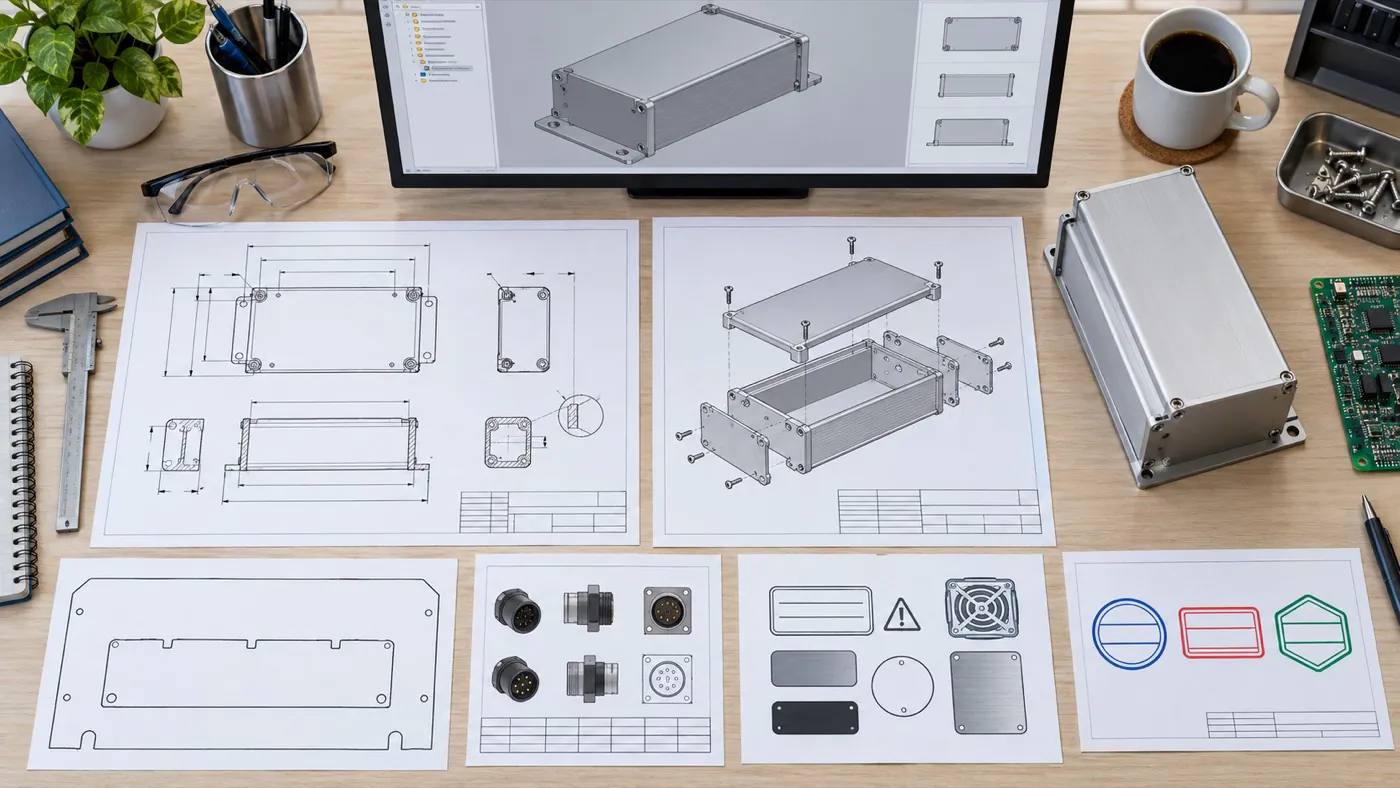
Illustrative specification package: environmental requests should be attached to the same controlled product definition as dimensions and finishes.
- Define the product boundary. State whether the request covers the empty housing, finished and marked parts, packaging, or the complete electronic device. These are different deliverables.
- Name the evidence. A material identification document, a recycled-content declaration, and a carbon-footprint study answer different questions. Specify which one the project needs.
- Set priorities. Identify mandatory requirements and preferred improvements. A purchasing preference should not silently override a critical mounting or protection requirement.
- Assign responsibility. The OEM should decide who reviews environmental information and who approves changes to the finished device. Record any unresolved assumptions before ordering.
Avoid asking suppliers to sign a broad claim that the supplied part cannot substantiate. Request a narrower, verifiable statement instead.
Statement: A general description such as “green aluminum” is enough to define an enclosure purchasing requirement.
Answer: False
Explanation: The buyer needs a defined scope and supporting evidence to understand what the description actually covers.
Which Documents Should Buyers Request for Material and Environmental Claims?
Request documents that match the specific claim and supplied product. A general statement about aluminum cannot establish the material origin, recycled content, or environmental performance of an individual enclosure order.
| Question to resolve | Information to request | Acceptance check |
|---|---|---|
| What material is specified? | Alloy designation, condition where relevant, and agreed identification records | Matches the approved part specification |
| Is recycled content being claimed? | Declared content, definition, scope, and supporting traceability | Applies to the supplied material rather than an unrelated product |
| Is a carbon footprint being compared? | Study boundary, calculation method, reporting period, and represented product | Alternatives are compared on a consistent basis |
| What finish is supplied? | Process description and agreed appearance and functional requirements | Matches the approved drawing and sample |
| What happens after a change? | Notification process and revised supporting documents | Affected requirements are reviewed before substitution |
The International Aluminium Institute’s carbon-footprint methodology addresses primary aluminum production and associated cradle-to-gate partial footprints. That scope is not automatically a footprint for a machined, finished enclosure or complete device. 1
Use the table to build a document request, not to imply every supplier has every report available. Confirm availability before making a document a purchase condition.
Statement: An upstream aluminum carbon-footprint figure automatically describes the complete finished electronic product.
Answer: False
Explanation: The reported boundary may exclude machining, finishing, transport, electronics, use, and other stages relevant to the buyer’s comparison.
When Can an Existing Profile Support a More Practical Design?
An existing profile is worth evaluating when its cross-section, mounting features, and usable space meet the product requirements. It can provide a starting point for custom length and panel machining, but suitability and environmental benefit are separate judgments.
| Design decision | Practical question | Limit to keep visible |
|---|---|---|
| Reuse a profile | Can the PCB, component heights, and connector access fit? | Width and height are constrained by the profile |
| Customize end panels | Can interfaces be accommodated without weakening important features? | Opening geometry and edge clearances require review |
| Share a housing across models | Can different panels support related SKUs? | An oversized common housing may create other compromises |
| Choose a dedicated route | Does the product need a fundamentally different structure? | Tooling and process requirements must be evaluated separately |
- Start with the PCB envelope. Include components, connector mating space, cable bends, and the customer’s installation sequence.
- Review the whole route. Extrusion with secondary machining, die casting, and machining a housing from stock are different manufacturing choices. Compare feasible proposals for the actual geometry and quantity.
- Keep benefits conditional. Reusing a suitable design may simplify development. It does not prove lower emissions, lower cost, immediate availability, or no tooling requirement for every project.
PUMAYCASE can assess existing extruded enclosure options before evaluating a dedicated solution where the existing structures do not fit.
Statement: Reusing a standard profile proves that an enclosure has a lower carbon footprint.
Answer: False
Explanation: Profile reuse is a design choice; an environmental comparison needs data for the relevant manufacturing and supply conditions.
How Should Finish Selection Balance Function and Environmental Requests?
Select the finish against actual appearance and use requirements, then request evidence for any environmental claim about that process. A finish name or color alone does not establish its environmental impact.
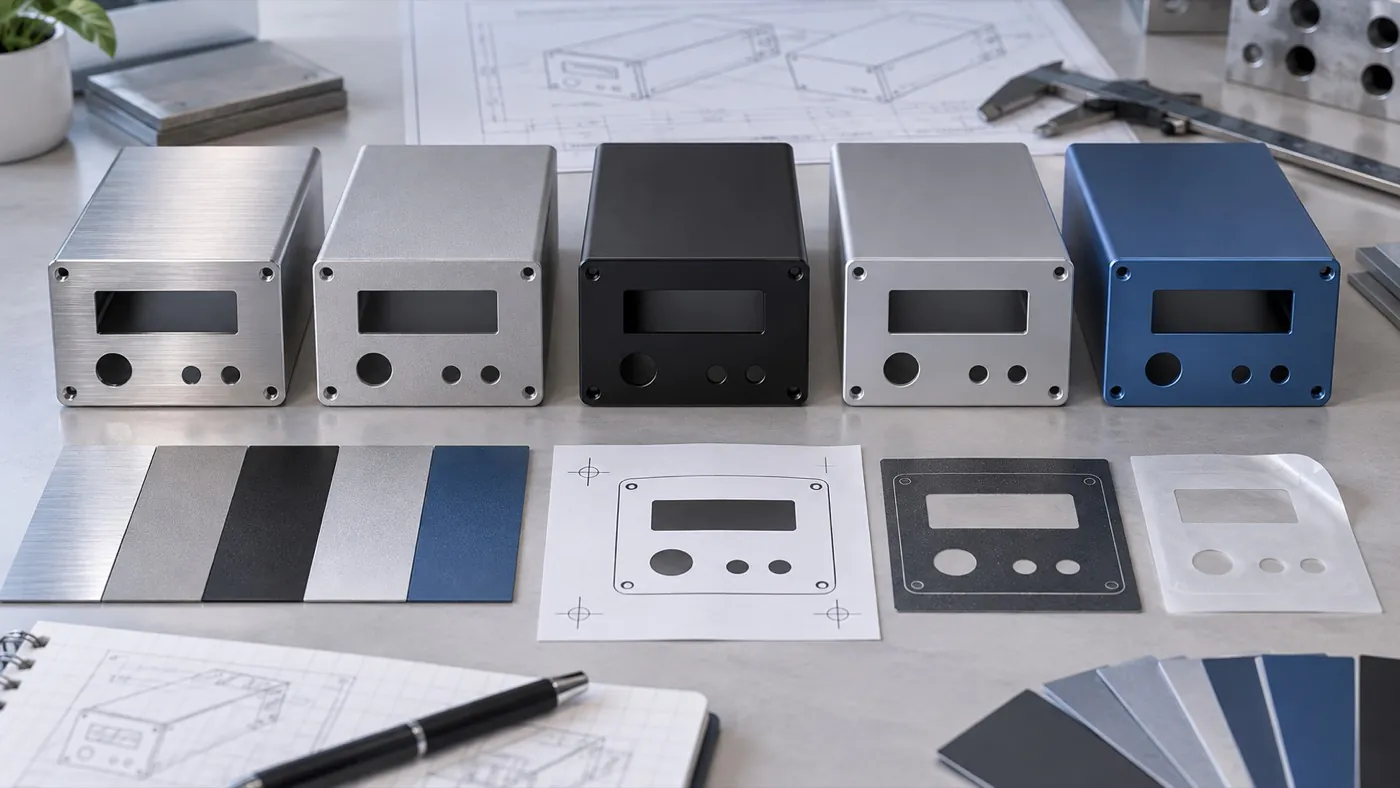
Illustrative finish and marking samples for defining an agreed appearance and acceptance standard.
- Specify the exposure. Describe indoor or outdoor use, cleaning methods, handling, and likely contact conditions so a proposed finish can be reviewed appropriately.
- Identify functional surfaces. Mark threads, mating areas, and electrical or thermal interfaces that need separate requirements. Confirm the intended condition on the drawing.
- Approve a representative sample. Review texture, color, marking contrast, and visible-face criteria together. A photograph alone may not settle an appearance disagreement.
- Question process claims. If reduced emissions or a particular chemical restriction is important, ask what evidence covers the specific process and supplied parts. Do not infer it from “anodized” or “powder coated.”
PUMAYCASE supports finish and marking options including anodizing, powder coating, silk-screen printing, and laser marking, with the suitable combination and acceptance requirements confirmed by project.
Statement: A finish should be selected solely because its name sounds environmentally preferable.
Answer: False
Explanation: The finish must meet the product requirements, and any environmental advantage needs evidence relevant to the proposed process.
How Can Access and Part Identification Support Future Service?
Design the housing so the customer can reach intended service points and identify the correct replacement parts. Service access is useful only when the proposed procedure remains compatible with the device’s safety, sealing, and performance requirements.

Conceptual component layout for reviewing access and part relationships; it is not a validated service design.
- Define permitted service actions. Identify which panels may be opened, by whom, and under what conditions. Some products should only be serviced by qualified personnel.
- Check access in a sample. Review tool clearance, fastener engagement, cable obstruction, and the removal sequence with representative hardware.
- Identify replaceable parts. Put panel versions and marking artwork under revision control so a future order does not introduce incompatible connector openings.
- Plan revalidation. Specify the inspections or product tests required after service, especially where a joint contributes to environmental protection or electrical performance.
These are design considerations for the customer’s installation and service activities. PUMAYCASE does not provide electronic-product assembly or take responsibility for complete-system validation by default.
Statement: A removable enclosure panel alone proves that the finished device can be safely repaired.
Answer: False
Explanation: Access, procedures, hazards, replacement parts, and post-service checks must all be considered for the actual device.
How Should Packaging Improvements Be Evaluated?
Evaluate packaging against both material use and the condition in which parts arrive. Reducing protection without checking the shipment can create damaged finishes, rework, and replacement deliveries.
| Proposed change | What to check before approval | Record to retain |
|---|---|---|
| Reduce individual wrapping | Whether adjacent parts can rub or strike each other | Approved separation arrangement |
| Change cushioning | Support at corners, panels, and protruding features | Packing sample and relevant shipment checks |
| Use a returnable container | Return route, handling responsibility, and expected reuse | Agreed operating plan |
| Improve material separation | Whether the receiving team can identify and separate components | Packing instructions and material descriptions |
- Define acceptable arrival condition. Identify cosmetic faces and features that need protection instead of relying on a vague “export packing” request.
- Trial the actual arrangement. Use representative finished parts, quantities, and distribution conditions; record issues before changing repeat-order packing.
- Confirm the destination’s handling options. Ask the receiving team which materials it can actually separate and route for recovery. Do not assume identical facilities in every country.
The aluminum enclosure packaging checklist provides a separate framework for documenting protection and receiving checks.
What Should Go Into the Final Supplier Review Package?
Combine the approved mechanical definition with a short environmental evidence register. This gives purchasing a way to distinguish confirmed requirements from proposed improvements and information that remains unavailable.
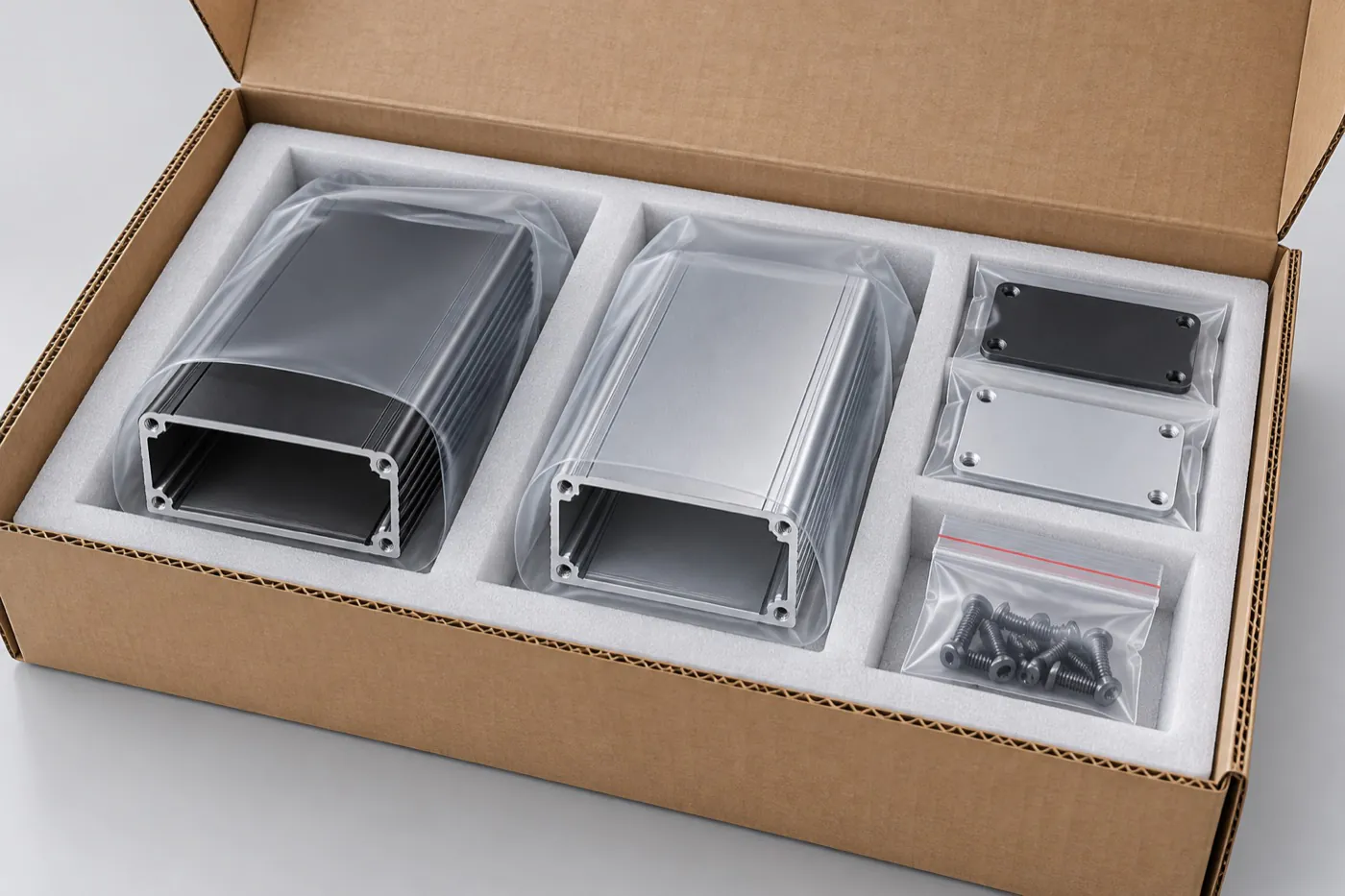
Conceptual packaging arrangement: protection, material choices, and packing instructions need project approval.
- Release one specification set. Include drawings, material identification, finish and marking requirements, sample decisions, and packaging instructions.
- List each claim and its evidence. Record document scope, issuer, date, and any limitation. Keep unsupported claims out of product marketing and supplier comparisons.
- Define change notification. Agree which material, process, finish, or packing changes need review before the next order.
- Close sample-stage questions. Assign an owner to unresolved fit, appearance, access, and performance checks before committing to repeat supply.
A useful outcome is a supply specification that can be checked again on the next order, with environmental statements limited to what the available evidence supports.
Conclusion
Evaluate sustainable aluminum enclosure choices by connecting product requirements to material evidence, a suitable manufacturing route, finish selection, service access, and verified packaging. Existing profiles can be a useful starting point when they fit, while environmental claims require their own supporting information. Share your PCB envelope, enclosure drawings, finish requirements, quantities, and specific documentation needs with PUMAYCASE to assess the appropriate enclosure and customization path.
References
[1] International Aluminium Institute. Aluminium Carbon Footprint Methodology.