How to Design IP67/IP68 Aluminum Enclosures for Industrial IoT Gateways
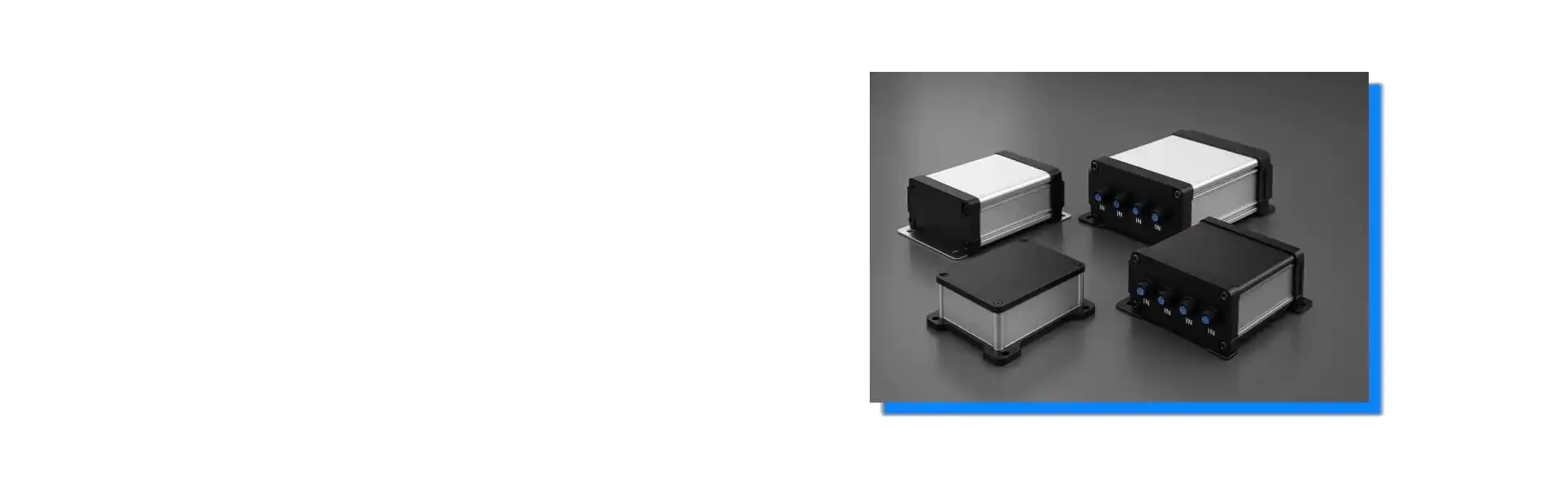
Industrial IoT gateways are often installed in environments that are far less controlled than the electronics inside them. A gateway may be mounted on a factory wall, inside an outdoor cabinet, near a production line, beside pumps and motors, or in a remote monitoring station exposed to dust, moisture, vibration, temperature change, and cable movement.
For this reason, the enclosure is not only a mechanical housing. It becomes part of the product's reliability system. A well-designed IP67 or IP68 aluminum enclosure must protect the PCB, support stable heat dissipation, allow accurate connector access, preserve antenna performance, and remain practical for CNC machining and batch production.
This guide explains how engineering and purchasing teams should specify IP67/IP68 aluminum enclosures for industrial IoT gateways before requesting a custom quotation.
Start with the Real Installation Environment
IP67 and IP68 are both related to dust-tight protection and water ingress resistance under IEC 60529, but they do not describe every field condition by themselves. A gateway installed under rain, washdown, condensation, UV exposure, cable pulling, vibration, or coastal corrosion may need additional design review beyond the IP code.
Before choosing an enclosure structure, define the installation conditions:
| Requirement | Questions to confirm |
|---|---|
| Installation location | Indoor cabinet, outdoor wall, machinery frame, vehicle, pole, or marine-adjacent area |
| Water exposure | Rain, splash, hose-down, temporary immersion, or continuous immersion |
| Dust exposure | Factory dust, cement dust, metal particles, agricultural dust, or road dust |
| Temperature | Ambient range, solar load, internal heat generation, and duty cycle |
| Mounting | DIN rail, wall mount, bracket, rack, desktop, or equipment-integrated |
| Cable direction | Bottom entry, side entry, rear entry, or mixed connector layout |
| Service access | Whether SIM, SD card, battery, or DIP switch access is required |
The enclosure manufacturer can only review sealing and machining risk correctly when these conditions are known.
Do Not Treat the IP Rating as a Gasket Selection Only
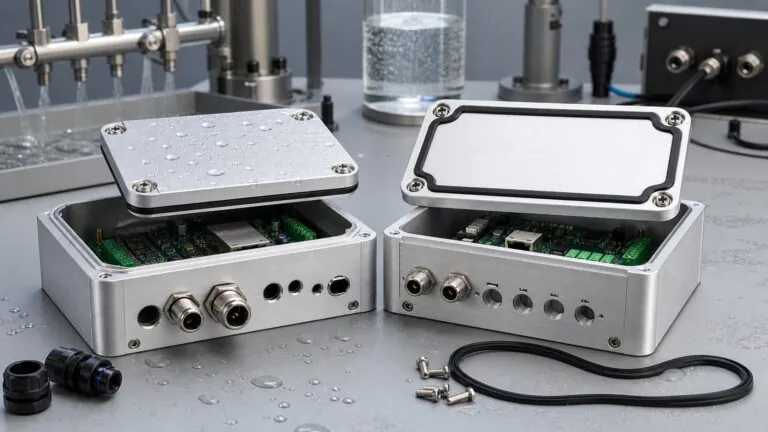
A common mistake is to select a waterproof enclosure first and add connector holes later. For an industrial IoT gateway, every CNC cutout changes the sealing system. Ethernet ports, M12 connectors, SMA antenna connectors, cable glands, LED windows, reset buttons, and vent elements can all become leakage points if their position, tolerance, flatness, and fastening method are not planned together.
A reliable design should define:
- Gasket material and groove position
- Screw spacing and compression control
- Mating surface flatness
- Wall thickness around each connector
- Minimum distance from cutouts to gasket lines
- Cable gland thread size and sealing washer area
- Whether the connector itself carries an IP rating after installation
- Burr removal and edge treatment after CNC machining
For procurement teams, this means an IP67/IP68 claim should be connected to the finished assembly, not only the empty metal housing. If the gateway needs multiple interfaces, the supplier should review the panel layout before confirming the final waterproof direction.
Plan Thermal Paths Before Closing the Box
Aluminum enclosures are widely used in electronic enclosures because it can be extruded into complex shapes and can help spread heat away from internal components. In electronics thermal management, aluminum and copper are common heat-conductive materials; aluminum also has the practical advantage of lower weight and extrusion flexibility.
However, a sealed waterproof enclosure has less natural airflow than a vented indoor housing. This makes the internal heat path more important. If the PCB, processor, power module, or wireless module generates heat, the design should create a controlled path from the component to the enclosure body.
Useful options include:
- Internal mounting bosses positioned near heat sources
- Thicker aluminum wall areas for heat spreading
- Thermal pads between components and the enclosure wall
- External fins or ribbed extrusion profiles
- Heat-generating components placed near the main enclosure body instead of isolated covers
- Avoiding unnecessary internal air gaps around power components
The goal is not only to make the enclosure strong. The goal is to make the enclosure part of the thermal design.
Protect Wireless Performance in a Metal Enclosure
Many industrial IoT gateways include 4G, 5G, Wi-Fi, Bluetooth, LoRa, GNSS, or other wireless functions. A fully metal enclosure can shield or weaken radio signals if antenna placement is not planned early. This is especially important for products intended for North America, Europe, India, New Zealand, and other export markets where wireless performance and compliance documentation matter.
Common design routes include:
- External antenna connectors on a CNC-machined panel
- Waterproof SMA or N-type connectors
- Plastic antenna windows in selected designs
- Internal antenna zones away from full metal shielding
- Cable strain relief for external antenna pigtails
- Grounding and EMC review for the complete device
For gateway manufacturers, antenna layout should be discussed at the enclosure design stage, not after the aluminum sample is finished.
Define CNC Cutouts with Manufacturing Tolerances
Industrial IoT gateways often require many panel features: Ethernet, USB, RS485, CAN, power input, reset button, LEDs, SIM access, antenna ports, grounding screws, cable glands, labels, and mounting holes. These details drive machining cost and sample accuracy.
For each cutout, provide:
- 2D drawing in PDF, DXF, or DWG
- 3D model in STEP or STP if available
- Connector datasheet
- Hole diameter or rectangular cutout size
- Reference edge dimensions
- Tolerance requirement
- Thread, countersink, or tapping details
- Surface finish requirement after machining
- Whether the opening affects waterproofing
When drawings are incomplete, the supplier can still begin with PCB size, component height, connector models, photos, and a simple sketch. But for waterproof-critical areas, final drawings should be controlled carefully before production.
Choose Surface Finish for Environment and Brand
Surface treatment affects corrosion resistance, appearance, printing quality, and batch consistency. Aluminum enclosures for industrial gateways commonly use anodizing, powder coating, brushing, sandblasting, laser engraving, or silk screen printing.
Anodizing is commonly used on aluminum alloys to improve corrosion and wear resistance and to support coloring effects. For outdoor or industrial use, finish selection should consider:
- UV exposure
- Salt mist or coastal environment
- Chemical exposure
- Brand color requirements
- Logo or warning label durability
- Scratch resistance during installation
- Color consistency across repeat orders
If the product will be installed outdoors, provide the environmental expectation during the quotation stage. This allows the supplier to recommend a practical finish before sample production.
Review Mounting and Service Access
Industrial IoT gateways are not always opened in clean workshops. Technicians may install them on machinery frames, outdoor poles, control cabinets, or equipment panels. The enclosure design should support practical field installation.
Important details include:
- DIN rail clips for control cabinets
- Wall mounting flanges or brackets
- Bottom cable entry to reduce water accumulation
- Captive screws where service access is frequent
- Clear grounding point
- Label area for serial number, model, and certification marks
- Avoiding screw locations blocked by cable glands or connectors
For serviceable products, avoid placing frequently accessed parts directly inside the main waterproof seal unless the maintenance process is clearly controlled.
Prepare a Better RFQ Package
A strong RFQ helps the manufacturer quote faster and reduces sample revision risk. For an IP67/IP68 industrial IoT gateway enclosure, include:
| RFQ item | Why it matters |
|---|---|
| Product application | Helps evaluate sealing, finish, and mounting requirements |
| Target IP rating | Defines waterproof direction and inspection expectations |
| PCB size and component height | Confirms internal clearance and thermal contact options |
| Connector list | Determines CNC cutouts and sealing risk |
| Cable gland specifications | Confirms thread size and washer sealing surface |
| Antenna requirement | Prevents RF performance problems in metal housing |
| Surface finish | Affects cost, lead time, corrosion resistance, and appearance |
| Quantity plan | Separates sample, pilot run, and batch pricing |
| Drawing files | Reduces interpretation errors |
| Packaging requirement | Supports export handling and finished-product delivery |
For a prototype, the first sample should verify mechanical fit, connector alignment, gasket compression, screw assembly, surface appearance, and practical installation. For production, the buyer should also confirm inspection standards and repeat-order consistency.
How PUMAYCASE Supports Custom Gateway Enclosure Projects
PUMAYCASE manufactures aluminum electronic enclosures, waterproof enclosures, tube extrusion enclosures, instrument chassis, 19 inch rackmount chassis, amplifier boxes, and CNC-machined enclosure parts for B2B export customers.
For custom enclosure manufacturing for industrial IoT gateway projects, PUMAYCASE can support:
- Existing aluminum enclosure profile selection
- Custom length cutting
- CNC holes and connector cutouts
- Waterproof enclosure customization
- Anodizing, powder coating, brushing, and printing
- Custom logo, silk screen, and laser engraving
- Prototype samples and batch production
- Engineering review from drawings, samples, photos, or early dimensions
For many gateway projects, starting from an existing extrusion profile can reduce tooling cost and shorten the first sample cycle. Fully custom structures can also be reviewed when the project requires a unique size, mounting method, or thermal profile.
Final Procurement Checklist
Before placing an order for an IP67/IP68 aluminum enclosure, confirm these points:
- Is the IP target based on the empty enclosure or the finished assembly?
- Are all connector openings reviewed for sealing?
- Does the design provide a heat path from the PCB to the aluminum body?
- Are wireless antenna positions compatible with a metal enclosure?
- Are CNC tolerances defined on waterproof-critical features?
- Is the surface finish suitable for the working environment?
- Are mounting brackets, DIN rail clips, screws, gaskets, and cable glands included?
- Has the supplier reviewed sample inspection and batch consistency?
The best enclosure design is not the one with the highest rating on paper. It is the one that protects the electronics, supports installation, controls heat, allows stable communication, and can be manufactured consistently at the required quantity.
For custom industrial IoT gateway enclosures, send your drawings, connector list, target IP rating, surface finish requirement, and sample quantity to PUMAYCASE for engineering review and quotation.
FAQ
Is IP68 always better than IP67 for an industrial IoT enclosure?
Not always. IP68 usually relates to conditions beyond IP67, but the exact depth and duration must be defined by the manufacturer and test requirement. If the product is exposed to rain or washdown rather than immersion, connector sealing and cable entry may matter more than choosing the highest number.
Can aluminum enclosures be used for wireless gateways?
Yes, but antenna design must be reviewed. Many gateways use external waterproof antenna connectors or specific antenna window structures to avoid signal loss from a fully enclosed metal body.
What files should I send for CNC cutouts?
Send PDF drawings for dimensions, DXF or DWG files for 2D cutouts, STEP files for 3D review, and connector datasheets for fit confirmation.
Can PUMAYCASE make small sample quantities?
PUMAYCASE supports prototype and small-batch custom enclosure projects, including CNC cutouts, surface finish, printing, logo customization, and later batch production planning.
What affects the price of a waterproof custom aluminum enclosure?
The main factors include enclosure size, profile type, quantity, CNC cutout complexity, gasket structure, cable glands, surface finish, printing, accessories, tolerance requirements, and whether new tooling is needed.
References
- International Electrotechnical Commission, IEC 60529: Degrees of protection provided by enclosures (IP Code): https://webstore.iec.ch/en/publication/2452
- Electronics thermal management overview: https://en.wikipedia.org/wiki/Thermal_management_%28electronics%29
- Anodizing technical overview: https://en.wikipedia.org/wiki/Anodizing