
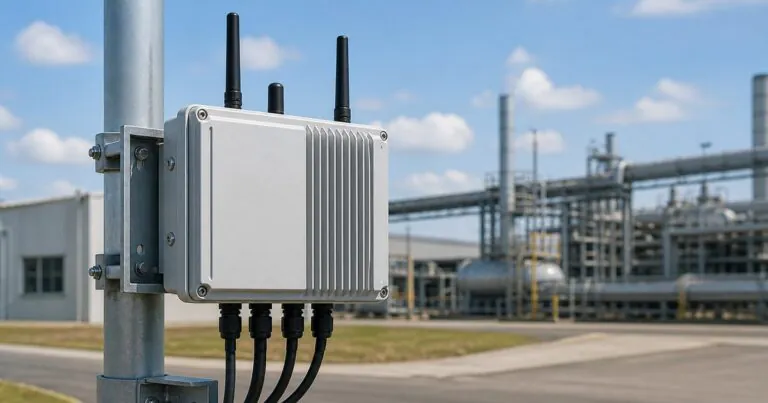
Outdoor 5G Gateway Aluminum Enclosure: How Can Engineers Balance IP67 Protection, Heat, and RF Performance?
Outdoor gateways need strong signals, but rain, heat, and sealed connectors create design risk. An outdoor 5G gateway aluminum enclosure can control these risks early.
An outdoor 5G gateway aluminum enclosure should protect electronics from dust and water, spread heat through aluminum, support antenna spacing, keep EMC contact, and allow CNC changes for connectors, glands, and mounting.
%outdoor 5G gateway aluminum enclosure with IP67 cable glands and CNC machined antenna ports
I see more engineers building gateways for smart factories, remote sensors, EV charging sites, and renewable energy monitoring. The device is small, but the enclosure work is not small. Jeff must think about the PCB, modem, antenna, heat source, cable entry, gasket, surface finish, and lead time at the same time. In this article, I will explain how I plan these details with customers before CNC machining starts.
Table of contents
- 1. How Should an Outdoor 5G Gateway Aluminum Enclosure Keep IP67 Protection?
- 2. How Can Aluminum Help Heat Dissipation In A Sealed 5G Gateway?
- 3. How Should Engineers Plan Antennas, EMC, and CNC Machining Together?
- Conclusion
1. How Should an Outdoor 5G Gateway Aluminum Enclosure Keep IP67 Protection?
Water finds weak points, and every connector becomes a possible leak path. If sealing is planned late, testing becomes expensive. Good enclosure design starts with openings.
An outdoor 5G gateway aluminum enclosure keeps IP67 protection by controlling gasket compression, cable gland position, connector sealing, screw torque, surface flatness, and test configuration before prototype production.
%IP67 outdoor 5G gateway aluminum enclosure with gasket groove and waterproof connector layout
When I review a waterproof gateway design, I first count the openings. I do not only look at the enclosure body. I look at Ethernet ports, DC power connectors, SIM card covers, antenna ports, wall-mount holes, pressure vents, and service screws. One weak opening can reduce the protection level of the whole device.
Start With The Leak Paths
The IEC explanation of IP ratings is a useful reference because it reminds engineers that IP67 is about dust-tight protection and temporary water immersion under defined test conditions. It does not mean every outdoor problem is solved. Sun load, cable bending, condensation, and field assembly can still damage the product.
For many waterproof aluminum enclosures, I ask customers to freeze the connector list before we machine the first sample. If Jeff changes from an M12 connector to a cable gland after testing, the gasket area and cable route may also need a change. That is why clear drawings save time.
| Design Point | Common Risk | Practical Check |
|---|---|---|
| End plate gasket | Uneven compression | Check groove depth and screw spacing |
| Cable gland | Wrong cable diameter | Match gland range with real cable OD |
| Antenna connector | Water path around thread | Use sealed bulkhead connector and washer |
| Mounting holes | Hidden leak path | Keep holes outside the sealed cavity |
| Service cover | Field assembly error | Add torque note and gasket position mark |
I also suggest one complete test sample with the real cable glands, real blanking plugs, and real antenna connectors. A bare enclosure test can pass, but the assembled gateway can fail. This is a painful lesson for many teams. The enclosure is only one part of the waterproof system.
IP67 gateway sealing should start with the real opening list.True
This is true because I see the same pattern in real enclosure projects. A small design note can prevent a larger prototype delay.
2. How Can Aluminum Help Heat Dissipation In A Sealed 5G Gateway?
5G modules create heat, but outdoor boxes often cannot use vents. Heat then stays near chips. Aluminum helps when the heat path is designed early.
Aluminum helps a sealed 5G gateway by moving heat from the PCB to the enclosure wall through bosses, pads, ribs, or contact plates, then releasing heat through the outer surface.
%sealed aluminum enclosure for 5G gateway with thermal pad contact and CNC machined heat path
I often ask one simple question: where does the heat go after it leaves the module? If the answer is only "inside the air," the design is not ready. In a sealed enclosure, internal air movement is limited. The better path is chip to thermal pad, pad to aluminum wall, wall to outside air.
Build A Direct Heat Path
Aluminum is useful because it conducts heat much better than many plastics. Engineering ToolBox lists aluminum thermophysical properties, including high thermal conductivity values around room temperature. In real enclosure work, this means the housing can become part of the cooling design.
For a 5G gateway, the modem, processor, and power section may sit in different places. I prefer to mark each heat source on the 3D model. Then I check whether the enclosure has enough wall thickness, enough contact area, and enough outside surface. If the enclosure is extruded, we can also use ribs or thicker local sections. If the panel is CNC machined, we can add a flat contact land for a thermal pad.
| Heat Detail | Better Choice | Why It Helps |
|---|---|---|
| Module contact | Thermal pad to aluminum wall | Reduces hot spots |
| Wall thickness | Stable wall near heat source | Improves spreading |
| Outer surface | Fins or ribs when space allows | Adds surface area |
| PCB gap | Controlled by bosses | Keeps pad compression stable |
| Finish | Anodizing with clear contact plan | Protects surface without losing key grounding points |
I also remind customers that sealing and heat are connected. If Jeff asks for IP67 and a high-power radio in a small box, we must avoid guessing. A quick thermal estimate is useful before prototype. A real temperature test is better before pilot production. PUMAYCASE can support custom aluminum enclosure solutions with CNC machined contact areas, anodizing, and small-batch samples, so the engineering team can test the heat path before the schedule becomes tight.
Aluminum only helps heat when the thermal path is designed.True
This is true because I see the same pattern in real enclosure projects. A small design note can prevent a larger prototype delay.
3. How Should Engineers Plan Antennas, EMC, and CNC Machining Together?
Wireless gateways need RF performance, but aluminum can block signals and poor grounding can increase noise. A smart layout separates antenna needs from shielding needs.
Engineers should plan antennas, EMC, and CNC machining together by defining antenna locations, connector types, conductive contact areas, grounding points, and machining tolerances before releasing drawings.
Aluminum is strong for protection, heat, and shielding, but it also changes RF design. If the antenna is inside a fully closed aluminum box, the signal can become weak. If the antenna connector is outside but the cable route is messy, the assembly can become hard to repeat. I like to discuss RF, EMC, and machining in one meeting because these details touch each other.
Keep RF Open And Grounding Clear
NIST has discussed the growth of connected devices and intelligent edge systems in manufacturing, and the 2026 AI and machine learning roadmap for smart manufacturing also shows why more sensing and connected control hardware is moving closer to machines. This trend makes gateway enclosure design more important.
For RF, Jeff should decide whether the design uses external antennas, internal antennas behind a plastic window, or remote antennas on cables. For EMC, he should decide where conductive contact is needed. Anodizing is useful for corrosion resistance and appearance, and ISO describes protective anodic oxidation coatings on aluminium. But anodizing is also an insulating surface, so grounding areas may need masking, conductive hardware, or a machined contact point.
| Engineering Need | Enclosure Decision | CNC Detail |
|---|---|---|
| External antenna | Bulkhead connector on end plate | Accurate hole and flat sealing face |
| Internal antenna | Non-metal RF window | Pocket or insert location |
| EMC contact | Conductive path to enclosure | Masked or machined grounding land |
| Label clarity | Port and SIM marking | Laser marking or silk screen |
| Fast prototype | Modular end plate | CNC change without new extrusion tooling |
This is where CNC aluminum enclosure machining becomes valuable. If a customer changes from two antennas to four antennas, we can often modify the end plate faster than changing the whole enclosure body. For extruded aluminum enclosures, this is one reason I like modular construction. The profile stays stable, and the panels carry most of the customization.
I also suggest that Jeff include connector datasheets, antenna clearance notes, grounding notes, and 3D PCB files in the RFQ package. This helps my engineering team reply clearly within 24 hours. It also reduces back-and-forth questions during a busy prototype week.
RF layout, EMC contact, and CNC machining should be reviewed together.True
This is true because I see the same pattern in real enclosure projects. A small design note can prevent a larger prototype delay.
Conclusion
An outdoor 5G gateway aluminum enclosure works best when IP67 sealing, heat dissipation, RF layout, CNC machining, anodizing, and lead time are planned together.