
EV Charging Controller Aluminum Enclosure: How Can Engineers Balance Heat, EMC, and IP67 Protection?
Outdoor chargers fail when heat, water, and EMI are treated late. Delays grow fast. I design the enclosure around these risks from day one.
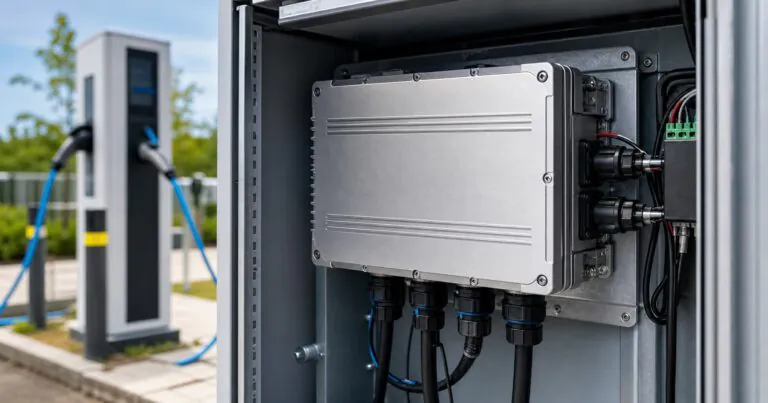
An EV charging controller aluminum enclosure protects control electronics by combining conductive aluminum, sealed CNC end plates, gasket design, EMC contact, anodizing, and clear assembly tolerances for outdoor charging hardware.
%EV charging controller aluminum enclosure with IP67 sealed CNC machined end plates
I see more engineers asking about compact controller boxes for EV charging stations, renewable energy equipment, and outdoor power devices. The enclosure is no longer only a cover. It becomes part of the thermal path, the shielding path, the sealing system, and the production schedule. In this article, I will explain how I review this kind of enclosure with product engineers before CNC machining starts.
Why Does An EV Charging Controller Aluminum Enclosure Need Early Thermal Planning?
Power electronics create heat in small spaces. If the path is unclear, components age faster. I start by mapping heat from the PCB to the aluminum body.
An EV charging controller aluminum enclosure needs early thermal planning because sealed outdoor boxes cannot depend on open airflow. Engineers must define heat sources, contact surfaces, wall thickness, mounting direction, and test conditions before machining.
%thermal path design for EV charging controller aluminum enclosure with heat dissipation
In my daily work, many thermal problems start with one sentence: “The housing is aluminum, so heat should be fine.” Aluminum helps, but it does not solve heat by itself. Heat must touch the enclosure through a real route. That route may use a thermal pad, a machined boss, a heat spreader plate, or direct contact between a module and the inner wall. If there is an air gap, the aluminum body cannot do its job.
The current EV charging trend makes this point more important. The IEA Global EV Outlook 2026 reports strong growth in public charging points and faster charging capacity. Even when the enclosure is for a controller, not the main power cabinet, the electronics often work near relays, communication modules, metering boards, and outdoor wiring. This makes temperature rise a real design question.
What I Check Before Quoting?
| Thermal question | Why it matters | Enclosure decision |
|---|---|---|
| Which parts create heat? | Heat sources are often small and concentrated. | Add bosses, pads, or local contact areas. |
| What is the ambient temperature? | Outdoor chargers may sit in sun or hot cabinets. | Review wall thickness and finish color. |
| Is the box fully sealed? | IP67 sealing reduces air exchange. | Use conduction first, not vents. |
| How is it mounted? | Fins and surfaces work differently by direction. | Confirm orientation before profile choice. |
For a compact controller, I usually prefer a practical test plan. I ask Jeff to share power loss, PCB position, and target surface temperature. Then we can choose a standard extruded body, a thicker custom profile, or custom aluminum enclosure solutions with CNC-machined contact points. Siemens also gives useful engineering background on enclosure thermal design and sealed systems in its electronics enclosure thermal design guide. I do not use simulation to replace samples. I use it to reduce blind guessing before the first prototype.
How Can IP67 Sealing Be Designed Without Creating Assembly Problems?
Water enters through small mistakes. A rushed gasket groove can ruin testing. I design sealing around compression, flatness, screws, and cable entries.
IP67 sealing works when the enclosure has controlled gasket compression, flat sealing faces, correct screw spacing, sealed connectors, and stable CNC tolerances. The drawing must define these details clearly.
IP67 is not only a marketing label. It is a design target. The official IEC 60529 IP Code classifies degrees of protection provided by enclosures. For engineers, the practical lesson is simple. Dust protection, water protection, gasket design, connector sealing, and assembly control must work together.
I often see a prototype pass a simple spray test but fail after cable glands are added. The reason is easy to understand. Every cutout is a possible leak path. A beautiful aluminum body cannot protect the product if the USB port, M12 connector, antenna hole, or pressure vent is not sealed correctly. This is why I ask for the connector model before machining. The hole size, thread depth, nut clearance, and gasket seat must match the real accessory.
What Makes Sealing Stable In Production?
| Sealing area | Common mistake | Better practice |
|---|---|---|
| End plate gasket | Groove too shallow or too deep | Define compression range with gasket supplier data. |
| Screw spacing | Wide spacing near corners | Add enough screws near sealing turns. |
| CNC flatness | No flatness note on drawing | Control the sealing face and avoid burrs. |
| Cable entry | Connector chosen after machining | Confirm connector model before CNC programming. |
For waterproof aluminum enclosures, I like modular thinking. The extrusion gives a stable body. CNC end plates give accurate ports. Silicone or EPDM gaskets give repeatable compression. Anodizing gives corrosion resistance, but masking may be needed on conductive contact areas. If the design needs a vent, the vent must be chosen for the IP target and the pressure change. A sealed outdoor charger controller can face sun, rain, washing, and cold nights. The enclosure must handle all of them without making assembly slow or confusing.
How Should Engineers Handle EMC, Anodizing, and CNC Customization Together?
EMC problems appear when surfaces lose contact. Anodizing can add insulation. I plan shielding, finish, and CNC details as one design package.
Engineers should handle EMC, anodizing, and CNC customization together by defining conductive contact zones, finish masking, screw grounding points, port locations, and tolerance notes before prototype machining.
%custom CNC machined aluminum enclosure with EMC shielding contact zones and black anodizing
Aluminum is useful for EMC because it is conductive, but the final enclosure is only as good as its contact path. If the body is anodized everywhere, the oxide layer can reduce electrical contact between the end plate and the body. This is not always a problem, but it must be intentional. In some projects, the customer wants a clean black anodized housing and also needs stable grounding. In that case, we can mask small areas, add serrated washers, or define bare metal contact points after machining.
The Aluminum Anodizers Council explains that anodic finishes are controlled oxide layers with different appearance and performance characteristics. For enclosure work, I care about coating thickness, color stability, corrosion resistance, and whether the finish affects fit. Threaded holes, sliding grooves, and tight-fitting covers may need special notes.
What Should Be On The Drawing?
| Design item | Drawing note to include | Why it helps the supplier |
|---|---|---|
| Port cutouts | Connector model and tolerance | Prevents loose or blocked assembly. |
| Grounding point | Masked or bare contact area | Keeps EMC path clear. |
| Surface finish | Anodizing color and type | Controls appearance and corrosion resistance. |
| Critical fit | 2D tolerance plus STEP file | Reduces back-and-forth before CNC. |
For CNC aluminum enclosure machining, I ask for both STEP and PDF drawings. STEP helps us review geometry. PDF helps us read tolerances, finish notes, threads, and critical dimensions. This is especially important for EV charging controllers because the product may include signal connectors, power terminals, communication antennas, DIN rail mounts, or wall brackets. Each detail affects machining time and lead time.
I also ask about the first order size. A prototype of 2 pieces has a different cost structure than a pilot run of 50 pieces. If Jeff tells me the likely second batch, I can suggest a design that supports small-batch production without redesign. Sometimes a standard extruded aluminum enclosure with CNC end plates is the fastest path. Sometimes a custom profile is better if heat, mounting, and branding all matter. My job is to help the engineer choose the route with less risk.
Conclusion
An EV charging controller aluminum enclosure works best when heat, EMC, IP67 sealing, anodizing, CNC machining, and lead time are reviewed together before production.
EV Charging Controller Aluminum Enclosure: How Can Engineers Balance Heat, EMC, and IP67 Protection?
Outdoor chargers fail when heat, water, and EMI are treated late. Delays grow fast. I design the enclosure around these risks from day one.
An EV charging controller aluminum enclosure protects control electronics by combining conductive aluminum, sealed CNC end plates, gasket design, EMC contact, anodizing, and clear assembly tolerances for outdoor charging hardware.
%EV charging controller aluminum enclosure with IP67 sealed CNC machined end plates
I see more engineers asking about compact controller boxes for EV charging stations, renewable energy equipment, and outdoor power devices. The enclosure is no longer only a cover. It becomes part of the thermal path, the shielding path, the sealing system, and the production schedule. In this article, I will explain how I review this kind of enclosure with product engineers before CNC machining starts.
Why Does An EV Charging Controller Aluminum Enclosure Need Early Thermal Planning?
Power electronics create heat in small spaces. If the path is unclear, components age faster. I start by mapping heat from the PCB to the aluminum body.
An EV charging controller aluminum enclosure needs early thermal planning because sealed outdoor boxes cannot depend on open airflow. Engineers must define heat sources, contact surfaces, wall thickness, mounting direction, and test conditions before machining.
%thermal path design for EV charging controller aluminum enclosure with heat dissipation
In my daily work, many thermal problems start with one sentence: “The housing is aluminum, so heat should be fine.” Aluminum helps, but it does not solve heat by itself. Heat must touch the enclosure through a real route. That route may use a thermal pad, a machined boss, a heat spreader plate, or direct contact between a module and the inner wall. If there is an air gap, the aluminum body cannot do its job.
The current EV charging trend makes this point more important. The IEA Global EV Outlook 2026 reports strong growth in public charging points and faster charging capacity. Even when the enclosure is for a controller, not the main power cabinet, the electronics often work near relays, communication modules, metering boards, and outdoor wiring. This makes temperature rise a real design question.
What I Check Before Quoting?
| Thermal question | Why it matters | Enclosure decision |
|---|---|---|
| Which parts create heat? | Heat sources are often small and concentrated. | Add bosses, pads, or local contact areas. |
| What is the ambient temperature? | Outdoor chargers may sit in sun or hot cabinets. | Review wall thickness and finish color. |
| Is the box fully sealed? | IP67 sealing reduces air exchange. | Use conduction first, not vents. |
| How is it mounted? | Fins and surfaces work differently by direction. | Confirm orientation before profile choice. |
For a compact controller, I usually prefer a practical test plan. I ask Jeff to share power loss, PCB position, and target surface temperature. Then we can choose a standard extruded body, a thicker custom profile, or custom aluminum enclosure solutions with CNC-machined contact points. Siemens also gives useful engineering background on enclosure thermal design and sealed systems in its electronics enclosure thermal design guide. I do not use simulation to replace samples. I use it to reduce blind guessing before the first prototype.
How Can IP67 Sealing Be Designed Without Creating Assembly Problems?
Water enters through small mistakes. A rushed gasket groove can ruin testing. I design sealing around compression, flatness, screws, and cable entries.
IP67 sealing works when the enclosure has controlled gasket compression, flat sealing faces, correct screw spacing, sealed connectors, and stable CNC tolerances. The drawing must define these details clearly.
IP67 is not only a marketing label. It is a design target. The official IEC 60529 IP Code classifies degrees of protection provided by enclosures. For engineers, the practical lesson is simple. Dust protection, water protection, gasket design, connector sealing, and assembly control must work together.
I often see a prototype pass a simple spray test but fail after cable glands are added. The reason is easy to understand. Every cutout is a possible leak path. A beautiful aluminum body cannot protect the product if the USB port, M12 connector, antenna hole, or pressure vent is not sealed correctly. This is why I ask for the connector model before machining. The hole size, thread depth, nut clearance, and gasket seat must match the real accessory.
What Makes Sealing Stable In Production?
| Sealing area | Common mistake | Better practice |
|---|---|---|
| End plate gasket | Groove too shallow or too deep | Define compression range with gasket supplier data. |
| Screw spacing | Wide spacing near corners | Add enough screws near sealing turns. |
| CNC flatness | No flatness note on drawing | Control the sealing face and avoid burrs. |
| Cable entry | Connector chosen after machining | Confirm connector model before CNC programming. |
For waterproof aluminum enclosures, I like modular thinking. The extrusion gives a stable body. CNC end plates give accurate ports. Silicone or EPDM gaskets give repeatable compression. Anodizing gives corrosion resistance, but masking may be needed on conductive contact areas. If the design needs a vent, the vent must be chosen for the IP target and the pressure change. A sealed outdoor charger controller can face sun, rain, washing, and cold nights. The enclosure must handle all of them without making assembly slow or confusing.
How Should Engineers Handle EMC, Anodizing, and CNC Customization Together?
EMC problems appear when surfaces lose contact. Anodizing can add insulation. I plan shielding, finish, and CNC details as one design package.
Engineers should handle EMC, anodizing, and CNC customization together by defining conductive contact zones, finish masking, screw grounding points, port locations, and tolerance notes before prototype machining.
%custom CNC machined aluminum enclosure with EMC shielding contact zones and black anodizing
Aluminum is useful for EMC because it is conductive, but the final enclosure is only as good as its contact path. If the body is anodized everywhere, the oxide layer can reduce electrical contact between the end plate and the body. This is not always a problem, but it must be intentional. In some projects, the customer wants a clean black anodized housing and also needs stable grounding. In that case, we can mask small areas, add serrated washers, or define bare metal contact points after machining.
The Aluminum Anodizers Council explains that anodic finishes are controlled oxide layers with different appearance and performance characteristics. For enclosure work, I care about coating thickness, color stability, corrosion resistance, and whether the finish affects fit. Threaded holes, sliding grooves, and tight-fitting covers may need special notes.
What Should Be On The Drawing?
| Design item | Drawing note to include | Why it helps the supplier |
|---|---|---|
| Port cutouts | Connector model and tolerance | Prevents loose or blocked assembly. |
| Grounding point | Masked or bare contact area | Keeps EMC path clear. |
| Surface finish | Anodizing color and type | Controls appearance and corrosion resistance. |
| Critical fit | 2D tolerance plus STEP file | Reduces back-and-forth before CNC. |
For CNC aluminum enclosure machining, I ask for both STEP and PDF drawings. STEP helps us review geometry. PDF helps us read tolerances, finish notes, threads, and critical dimensions. This is especially important for EV charging controllers because the product may include signal connectors, power terminals, communication antennas, DIN rail mounts, or wall brackets. Each detail affects machining time and lead time.
I also ask about the first order size. A prototype of 2 pieces has a different cost structure than a pilot run of 50 pieces. If Jeff tells me the likely second batch, I can suggest a design that supports small-batch production without redesign. Sometimes a standard extruded aluminum enclosure with CNC end plates is the fastest path. Sometimes a custom profile is better if heat, mounting, and branding all matter. My job is to help the engineer choose the route with less risk.
Conclusion
An EV charging controller aluminum enclosure works best when heat, EMC, IP67 sealing, anodizing, CNC machining, and lead time are reviewed together before production.