Outdoor Aluminum Enclosure Corrosion Resistance: Design Guide for Industrial IoT Devices
Meta description: Specify outdoor aluminum enclosures with the right alloy, finish, gasket, fasteners, and salt spray checks for industrial IoT projects.
Why Corrosion Resistance Must Be Designed Before Quotation
For industrial IoT gateways, wireless sensor nodes, edge controllers, signal converters, outdoor power modules, and monitoring devices, the enclosure is the first protection layer against the environment. It is also one of the most common sources of hidden field risk.
A custom aluminum enclosure may look correct during sample approval. The CNC cutouts may align with the PCB, the anodized color may match the buyer's brand, and the cover may close smoothly. Yet after outdoor deployment, problems can appear at the details: white oxidation around screws, coating bubbles at machined edges, water marks near cable glands, corrosion around dissimilar metals, or unstable sealing after repeated temperature cycles.
These failures are rarely caused by one material choice alone. Corrosion resistance depends on the complete enclosure system:
- Aluminum alloy and profile design
- Surface finish and pretreatment
- CNC machining quality
- Edge protection after cutting
- Fastener and connector material compatibility
- Gasket design and compression
- Cable gland layout and sealing
- Condensation management
- Batch inspection before shipment
For OEM buyers, the practical goal is not only to buy a metal box. The goal is to specify an enclosure that can be manufactured repeatedly, assembled efficiently, and survive the actual installation environment.
Start With the Real Outdoor Environment
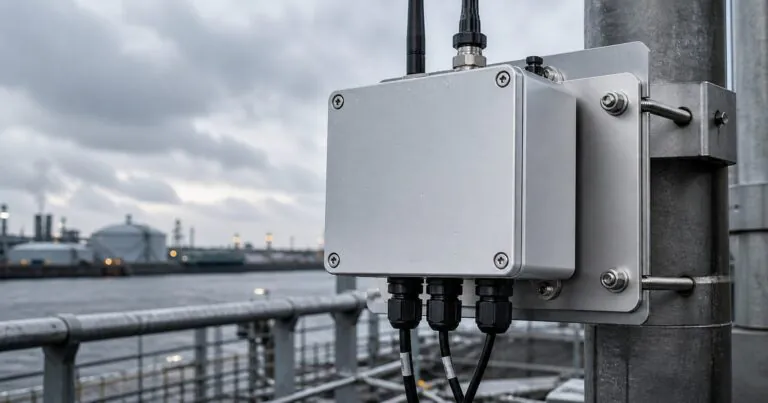
"Outdoor use" is not a complete engineering requirement. A wireless gateway installed inside a shaded factory yard faces a different corrosion profile from a sensor node near a coastal port, a solar monitoring device near fertilizer storage, or a roadside control module exposed to winter de-icing salts.
Before requesting a quotation, buyers should define the operating environment in plain engineering terms:
| Environment Factor | Why It Matters for Aluminum Enclosures | RFQ Detail to Provide |
|---|---|---|
| Rain and water spray | Drives sealing design, gasket compression, and cable gland selection | Required IP rating, mounting direction, cable entry direction |
| Coastal salt air | Increases corrosion risk at edges, screws, and coating defects | Distance from coast, expected salt exposure, finish preference |
| Industrial chemicals | Can attack coatings, seals, labels, and accessories | Chemical type, cleaning method, exposure frequency |
| UV exposure | Affects powder coating, labels, plastics, and gasket aging | Outdoor color requirement, UV stability need |
| Temperature cycling | Creates condensation and changes gasket compression | Operating and storage temperature range |
| Vibration | Can loosen screws and reduce seal pressure | Mounting method, vehicle or machine exposure |
This information helps the enclosure supplier choose the correct finish, gasket, machining tolerance, and accessory strategy. Without it, the quotation may be cheaper but less reliable.
6063 vs 6061 Aluminum for Outdoor Electronic Enclosures
Most custom aluminum electronic enclosures use 6000-series aluminum because it offers a practical balance of machinability, corrosion resistance, weight, strength, and surface finish quality. Two common choices are 6063 and 6061.
| Factor | 6063 Aluminum | 6061 Aluminum |
|---|---|---|
| Typical enclosure use | Extruded enclosure bodies, tube extrusion housings, visible profiles | CNC plates, brackets, stronger structural parts |
| Extrusion performance | Excellent for smooth and complex profiles | Good, but less ideal for complex thin-wall profiles |
| Surface appearance | Strong choice for decorative anodizing | Good, but may be less ideal for appearance-critical extrusion |
| Strength | Adequate for many electronic housings | Higher strength and rigidity |
| Machining | Good | Very good |
| Outdoor recommendation | Strong option for custom extrusion enclosures with anodizing or coating | Use where mechanical strength, heavy machining, or load-bearing features are important |
For industrial IoT projects, 6063 is often a cost-effective base material for extruded housings. It supports integrated PCB slots, internal screw bosses, heat-dissipation ribs, and smooth visible surfaces. 6061 is useful for front panels, mounting brackets, base plates, and parts that require higher rigidity.
The better question is not "Which alloy is best?" The better question is:
Which alloy best matches the profile shape, machining load, surface finish, mounting method, and outdoor exposure?
Surface Finish Is a Functional Requirement
Surface treatment is often discussed as a color or appearance decision, but for outdoor enclosures it is also a corrosion-resistance decision.
Anodizing
Anodizing creates a controlled oxide layer on the aluminum surface. It is popular for custom aluminum enclosures because it provides a clean appearance, good wear resistance, and attractive colors such as black, silver, blue, or custom tones.
For outdoor industrial electronics, anodizing is useful when the buyer needs:
- Professional metallic appearance
- Dimensional stability compared with thicker coatings
- Good handling resistance
- Color consistency across a series of products
- A finish suitable for extrusion profiles and machined panels
However, anodizing is not automatically the best choice for every outdoor environment. The oxide layer can be damaged at sharp edges, unprotected cutouts, and threaded holes if machining and finishing sequence are not controlled. Anodizing is also electrically insulating, so grounding points must be masked or machined after finishing when electrical continuity is required.
Powder Coating
Powder coating provides a thicker protective layer and broad color options. It is often selected for outdoor equipment because it can offer strong coverage and good appearance when pretreatment, coating thickness, curing, and edge coverage are well controlled.
Powder coating is useful when the buyer needs:
- Strong color coverage
- Outdoor visual durability
- Better coverage over larger panels
- Custom brand colors
- Additional protection at exposed surfaces
The risk is that powder coating can build thickness around edges, holes, threads, and mating surfaces. Drawings should clearly define areas that must remain uncoated, threaded, conductive, or dimensionally controlled.
Finish Comparison for Procurement
| Finish Option | Strengths | Watch Points | Best Fit |
|---|---|---|---|
| Clear or colored anodizing | Clean metallic appearance, good for extrusions, controlled thickness | Conductive zones need masking; edge quality matters | Industrial IoT housings, instrument shells, branded aluminum cases |
| Hard anodizing | Higher wear resistance and thicker oxide layer | Higher cost; color control may be limited | Harsh handling, wear-prone parts |
| Powder coating | Strong color coverage, thicker barrier, wide color options | Thread masking, grounding zones, coating build-up | Outdoor control boxes, branded equipment, larger panels |
| Anodizing plus selective machining | Good appearance with controlled grounding points | Requires clear drawings and inspection | EMI or grounding-sensitive outdoor electronics |
Corrosion Often Starts at CNC Cutouts and Edges
Outdoor enclosure failures often begin where the metal has been cut, drilled, tapped, or assembled.
For PUMAYCASE buyers, the most important CNC-related details are:
- Connector holes
- Antenna openings
- Cable gland flats
- Display windows
- Ventilation slots
- Mounting holes
- Threaded bosses
- Grounding points
- Cover screw holes
Every opening changes the protection system. A hole may expose fresh aluminum, interrupt coating continuity, create a burr that damages a gasket, reduce wall strength, or collect water if it is placed in the wrong orientation.
Practical CNC Recommendations
- Avoid sharp external corners where possible. Small radii improve coating coverage and reduce edge damage.
- Define deburring requirements. Burrs can cut gaskets, interfere with connector seating, and create weak coating points.
- Protect machined edges. If machining occurs after finishing, specify whether exposed edges are acceptable or require touch-up, sealing, or post-treatment.
- Use flat sealing lands around glands and connectors. Waterproof connectors need enough flat surface for reliable compression.
- Control hole position tolerance. Misaligned cutouts can force connectors into stress, damaging seals during assembly.
- Separate drainage paths from cable entries. A cable gland should not become the lowest water collection point unless the design intentionally handles it.
For connector-heavy IoT housings, a 2D panel drawing should identify critical dimensions, hole tolerance, surface finish, burr requirements, and sealing areas. A STEP file alone is not enough for a reliable RFQ.
Fasteners, Glands, and Galvanic Corrosion
Aluminum enclosures rarely work alone. They are assembled with screws, inserts, connectors, cable glands, labels, brackets, and sometimes DIN rail clips or wall-mount feet. When different metals touch in the presence of moisture, galvanic corrosion can become a risk.
Common outdoor enclosure interfaces include:
- Aluminum body with stainless steel screws
- Aluminum cover with brass cable glands
- Aluminum panel with nickel-plated connectors
- Aluminum mounting feet with steel brackets
- Grounding hardware with coated or anodized surfaces
The design does not always need to eliminate every dissimilar metal pair, but it should control the risk. Practical methods include:
- Use compatible fastener materials and coatings.
- Add sealing washers where water may track along screw threads.
- Avoid trapping moisture between flat metal surfaces.
- Use isolation washers or gaskets where appropriate.
- Keep drainage and cable orientation in mind.
- Define screw torque so gasket compression is repeatable.
- Avoid damaging the finish during assembly.
For export buyers, these small details can decide whether a product survives real outdoor conditions after the first rainy season.
Gasket Design and Condensation Control
An enclosure can be waterproof and still suffer internal corrosion if moisture is trapped inside. Outdoor electronics experience temperature cycles. Warm air inside the enclosure can cool and condense on internal surfaces, especially when the device is mounted in shade after daytime heating.
Gasket Design Priorities
The gasket should be treated as an engineered part, not an afterthought.
Key requirements include:
- Material: silicone or EPDM depending on temperature, UV, and chemical exposure
- Compression target: enough to seal, not so much that the gasket is permanently crushed
- Groove depth: matched to gasket section and cover pressure
- Screw spacing: close enough to maintain even compression
- Surface flatness: controlled mating surfaces for consistent sealing
- Assembly repeatability: clear torque or fastening guidance
Condensation Considerations
For some outdoor electronics, a fully sealed box may need additional design choices:
- Breathable vent membrane where pressure equalization is needed
- Internal coating or conformal coating on electronics
- Desiccant strategy for sensitive instruments
- Cable entry orientation that reduces water tracking
- Drainage logic for non-submerged applications
- Thermal design to reduce internal temperature swings
These choices depend on the device and environment. The important point is that IP rating, corrosion resistance, and thermal behavior should be reviewed together.
How to Use Salt Spray Testing Correctly
Salt spray testing is useful, but it is often overclaimed in marketing. A 240-hour or 500-hour salt spray result should not be presented as a direct guarantee of outdoor service life. Real outdoor corrosion depends on UV exposure, wet-dry cycling, pollutants, temperature, scratches, installation method, cleaning chemicals, and maintenance.
The better use of salt spray testing is process control:
- Detect coating discontinuities
- Compare sample preparation quality
- Check whether pretreatment is stable
- Find edge coverage problems
- Validate that the supplier can repeat a finish process
ISO 9227:2022 specifies salt spray methods such as neutral salt spray, acetic acid salt spray, and copper-accelerated acetic acid salt spray for assessing corrosion resistance of metallic materials with or without corrosion protection. It also notes that exposure period and interpretation are normally provided in the product specification, not by the test method alone.1
For buyers, the RFQ should define the test requirement carefully:
| RFQ Item | Better Specification Approach |
|---|---|
| Test method | State ISO 9227 NSS, AASS, or CASS if relevant |
| Sample type | Finished enclosure panel, coated coupon, or assembled part |
| Exposure time | Define hours only if meaningful for your product specification |
| Acceptance criteria | No blistering, no base metal corrosion, limited white corrosion, or visual standard |
| Edge condition | Clarify whether machined edges are included in evaluation |
| Reporting | Require photos, sample ID, finish batch, and test lab or internal record |
The purpose is to avoid vague claims and create a repeatable acceptance process.
RFQ Checklist for Outdoor Aluminum Enclosures
To receive a faster and more accurate quotation, OEM buyers should include the following information:
- Application: industrial IoT gateway, sensor node, power module, telecom device, test instrument, or other product.
- Environment: indoor, outdoor, coastal, chemical exposure, UV exposure, vibration, washdown, or temperature range.
- Target protection: required IP rating, mounting direction, cable entry position, and whether immersion is expected.
- Material preference: 6063 extrusion, 6061 machined part, or supplier recommendation.
- Finish: anodizing color and thickness, powder coating color and thickness, masking zones, or conductive zones.
- CNC details: 2D drawings with hole sizes, tolerances, connector models, gland thread sizes, and burr requirements.
- Gasket details: material, groove design, compression requirement, replacement need, and screw spacing.
- Fasteners: screw material, inserts, washers, grounding hardware, and torque requirements.
- Logo and marking: laser engraving, silk screen, label, or no marking.
- Inspection: key dimensions, coating checks, salt spray expectation, assembly fit, and sample approval criteria.
- Quantity: prototype quantity, first batch quantity, annual estimate, and target delivery schedule.
This information reduces quotation revisions and helps the supplier identify manufacturability risks before the first sample.
Sample Approval: What Buyers Should Inspect
Before approving batch production, inspect the enclosure sample as a complete system.
Mechanical and CNC Inspection
- Hole positions match connector drawings.
- Cable glands seat flat without rocking.
- Threads are clean and not blocked by coating.
- Burrs are removed from all cutouts.
- Cover and body alignment is consistent.
- Mounting slots match the installation method.
Finish and Corrosion-Risk Inspection
- Coating or anodizing color is consistent.
- Edges are smooth and protected as specified.
- No coating bubbles, scratches, or exposed defects are visible.
- Masked areas are clean and correctly located.
- Logo or marking does not damage the protection layer.
Sealing and Assembly Inspection
- Gasket sits evenly in the groove.
- Screws compress the cover evenly.
- Cable glands and connectors do not interfere with each other.
- Interior clearance is sufficient for PCB, wires, and heat sources.
- Grounding points remain conductive if required.
Batch production should follow the approved sample, but buyers should still request inspection photos or reports for critical projects.
How PUMAYCASE Supports Outdoor Enclosure Projects
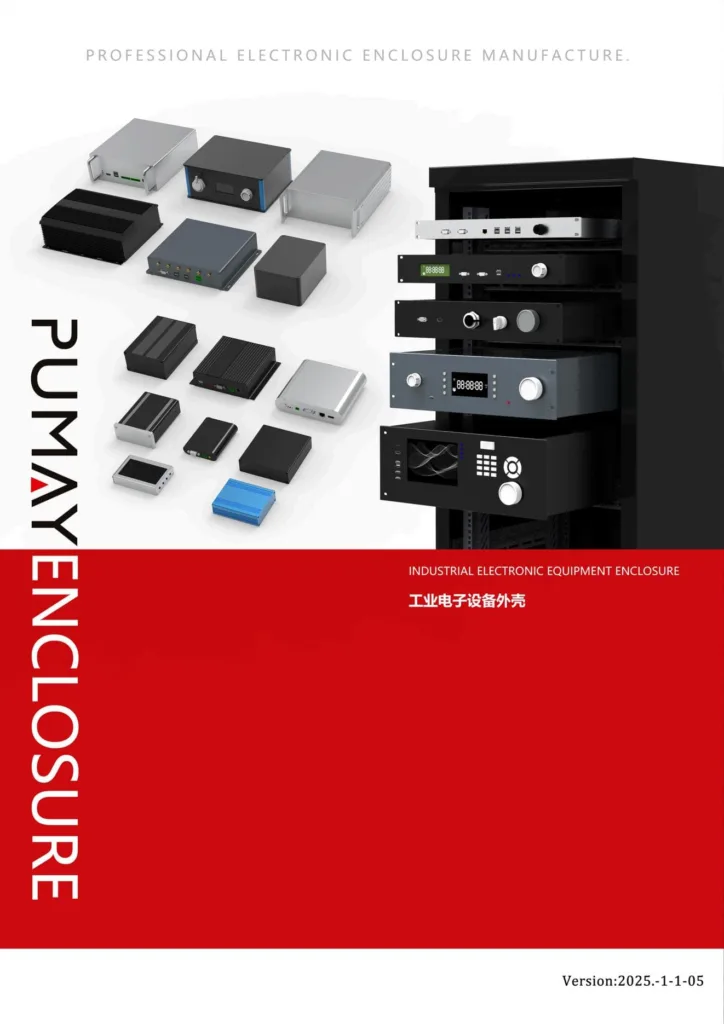
PUMAYCASE manufactures custom aluminum electronic enclosures, tube extrusion enclosures, instrument chassis, 19 inch rackmount chassis, amplifier boxes, and CNC machined enclosure parts for overseas B2B buyers.
For outdoor industrial IoT and automation devices, PUMAYCASE can support:
- Aluminum extrusion enclosure design
- 6063 and 6061 aluminum material selection
- CNC machining for connectors, displays, glands, and mounting holes
- Anodizing, brushing, powder coating, and logo customization
- Silicone or EPDM gasket planning
- Small-batch samples and repeat batch production
- Factory-direct export supply for OEM and ODM projects
If you are preparing an outdoor enclosure RFQ, send the 2D drawing, STEP file, PCB size, connector list, target finish, IP requirement, sample quantity, and expected annual volume. A complete drawing package allows the factory to review corrosion-risk details before tooling, machining, and surface treatment begin.
Conclusion
Outdoor aluminum enclosure corrosion resistance is not determined by one keyword such as "6063," "anodized," or "IP67." It is the result of coordinated engineering decisions across material, finish, machining, sealing, accessories, and inspection.
For industrial IoT buyers, the most reliable sourcing strategy is to specify the real environment, define critical cutouts and sealing interfaces, choose the finish for function as well as appearance, and approve samples with corrosion-risk details in mind.
A well-specified custom aluminum enclosure does more than protect electronics. It reduces field failure risk, shortens supplier communication, and gives procurement teams a repeatable path from prototype to stable batch production.
References
International Organization for Standardization, ISO 9227:2022, Corrosion tests in artificial atmospheres - Salt spray tests. ↩